Best Inflation Hedge for Retirement
Explore where physical gold and a Gold IRA may fit within a diversified retirement strategy.
Is Gold the Best Inflation Hedge?
Quick Answer: There is no single best inflation hedge for every investor. Physical gold is often considered because it is scarce, tangible, and independent of any single currency issuer. However, gold prices can rise or fall. Gold also does not track inflation reliably over every period. Therefore, its potential role is better evaluated within a diversified plan rather than as a guaranteed shield.
Inflation reduces purchasing power as the cost of goods and services changes over time. The U.S. Bureau of Labor Statistics tracks those price changes through the Consumer Price Index.
Gold and silver have long been used as stores of value. Still, historical use does not guarantee future performance. Precious metals can be volatile, do not produce income, and may underperform other assets for extended periods.
For retirement savers, the more useful question is not whether gold is always the best inflation hedge. Instead, ask whether a measured allocation may complement your existing assets, liquidity needs, risk tolerance, and time horizon.
Before making financial decisions, consider speaking with an independent financial, tax, or legal professional who understands your circumstances.
How a Gold IRA Can Fit an Inflation-Hedge Strategy
A Gold IRA is a self-directed IRA that can hold certain IRS-eligible precious metals. It does not make gold risk-free or guarantee better returns. Instead, it provides a retirement-account structure for qualifying physical bullion.
The IRS applies specific rules to precious metals held in IRAs. These include requirements involving eligible bullion and qualified custody. Review the IRS IRA guidance before acting.
What to Evaluate Before Using Retirement Funds for Gold
Consider the role gold would play in the entire portfolio. Then compare account eligibility, custodian arrangements, approved storage, purchase spreads, annual fees, liquidity, distributions, and your expected holding period.
Gold may behave differently from stocks, bonds, and cash during some economic periods. That difference can be useful, but it is not consistent.
A precious metals IRA can hold qualifying physical bullion rather than only securities tied to financial markets.
Gold can add another asset class to a retirement portfolio. The appropriate allocation depends on the individual investor.
Traditional and Roth tax treatment depends on the account type and applicable rules, not on gold itself.
IRA-owned precious metals generally require qualified custody and compliant storage arrangements under IRS rules.
Account fees, storage, insurance, dealer spreads, liquidity, and gold-price volatility all belong in the decision.
EXPLORE HOW A GOLD IRA CAN WORK

A Gold IRA is one possible diversification tool, not a promise of inflation protection. Learn how the structure works before deciding whether it belongs in your retirement plan.
What Makes a Strong Inflation-Hedge Strategy?
The best inflation hedge is rarely a single asset. A durable strategy may combine liquidity, productive assets, inflation-sensitive holdings, and other diversifiers based on your goals.
Physical gold has no corporate issuer and does not depend on a company’s earnings. However, its market price fluctuates. It also does not generate interest or dividends. Those trade-offs matter when evaluating its role in long-term wealth preservation.
For some investors, gold and silver may provide useful diversification during periods of inflation, currency concern, or geopolitical turmoil. For others, the costs, volatility, or lack of income may make a smaller allocation—or no allocation—more appropriate.
Best Inflation Hedge Information Center
EXPLORE GOLD AND LONG-TERM WEALTH PRESERVATION
Best Inflation Hedge FAQs
What is the best inflation hedge?
There is no universal best inflation hedge. Investors often compare real assets, equities, inflation-linked securities, cash reserves, and precious metals. The right mix depends on time horizon, liquidity needs, risk tolerance, taxes, and overall portfolio structure.
Is gold always a good hedge against inflation?
No. Gold has served as a store of value across long periods, but its price can move independently of consumer inflation. It may rise, fall, or remain flat while the cost of living changes.
Can physical gold be held in an IRA?
Yes. Certain qualifying bullion can be held in an IRA when applicable IRS requirements are satisfied. Rules involving eligible metals, trustees or custodians, storage, transactions, and distributions should be reviewed before funding the account.
What should I compare before opening a Gold IRA?
Compare eligibility, rollover or transfer procedures, custodian fees, storage and insurance, dealer spreads, eligible metals, liquidity, distributions, and the provider’s selling process. Also consider how much gold would fit the broader portfolio.
Sponsored Educational Resource — Augusta Precious Metals
Evaluate the Inflation Hedge Before You Fund It
BestInflationHedge.com starts with a simple principle: understand the structure before moving retirement money.
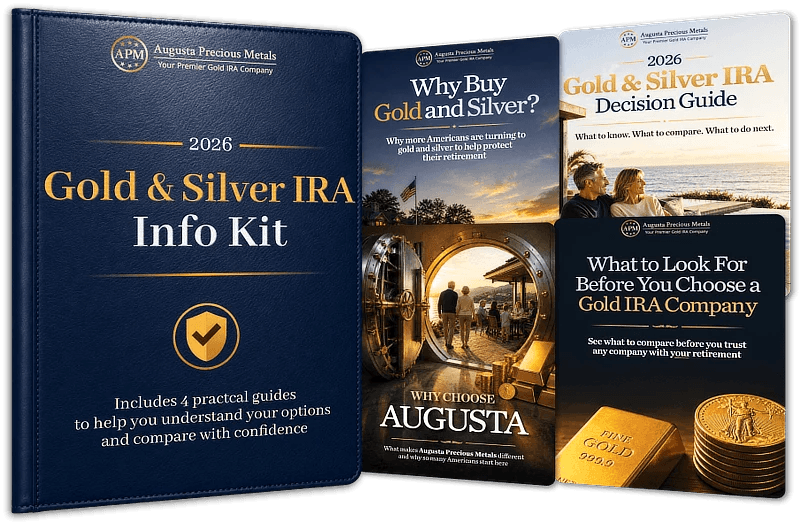
Augusta Precious Metals’ Gold Silver Info Kit can serve as a due-diligence starting point for investors considering physical gold inside a retirement account. Use the kit to prepare better questions before deciding whether a Gold IRA fits your plan.
- IRA rollovers, transfers, and account eligibility
- the roles of the custodian and depository
- which precious metals can qualify for an IRA
- account fees, storage costs, insurance, and dealer spreads
- liquidity, distributions, selling, and the exit process
➤ Review Augusta’s Free Gold Silver Info Kit
Requesting educational material does not obligate you to open an account. BestInflationHedge.com may receive compensation when visitors use sponsored links.
A Customer Perspective on Augusta Precious Metals
Watch Herbert Campbell explain why he chose Augusta Precious Metals for his gold and silver IRA. His experience is personal and should not be viewed as a guarantee of investment results.